
Why Fluoride Removal Matters
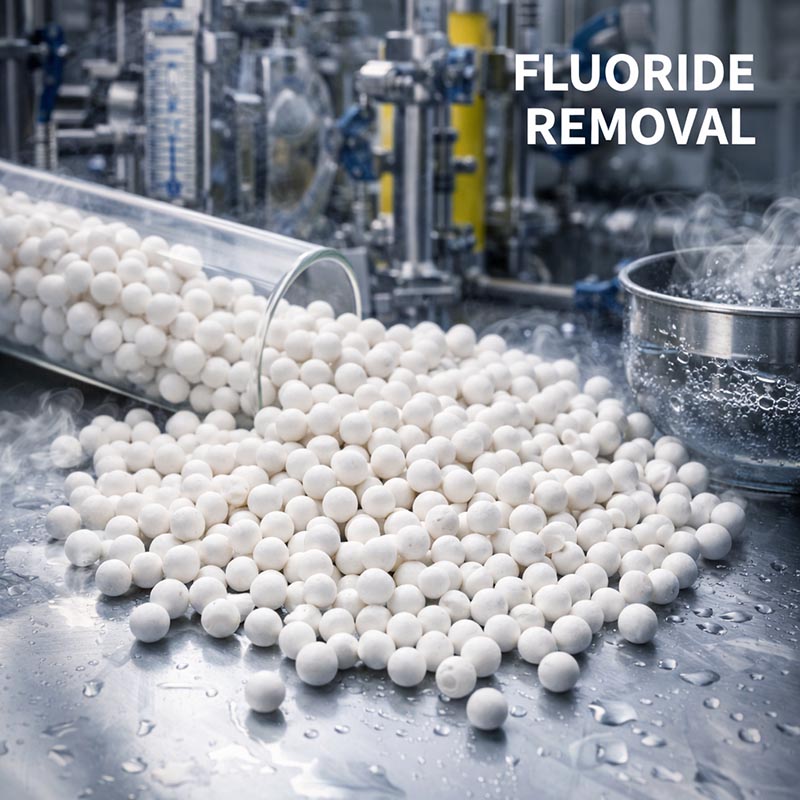
Fluoride is a naturally occurring element in groundwater, but excess fluoride (>1.5 mg/L) can cause dental and skeletal fluorosis. Communities relying on groundwater are particularly vulnerable.
Activated alumina is a proven, cost-effective solution for fluoride removal in drinking water. Unlike reverse osmosis or ion exchange, it combines simplicity, reliability, and regenerability, making it ideal for both small and medium-scale water treatment projects.
How Activated Alumina Removes Fluoride
Fluoride Adsorption Mechanism
Activated alumina (Al₂O₃) contains porous surfaces with hydroxyl groups (-Al–OH). Fluoride ions replace these hydroxyls through ligand exchange:
–Al–OH+F−→–Al–F+OH−
This reaction explains why pH control and surface activation are essential for optimal fluoride removal.
Factors Affecting Fluoride Adsorption
-
pH: Optimal range 5.5–6.0
-
Competing anions: Bicarbonate, phosphate, sulfate reduce adsorption
-
Pretreatment: Acid activation increases adsorption capacity 20–60%
Raw Water Requirements
Before using activated alumina, test raw water for:
| Parameter | Recommended Range | Impact |
|---|---|---|
| Fluoride | 2–20 mg/L | Determines bed size & cycle |
| pH | 6.5–8.5 | Requires adjustment |
| Alkalinity | <300 mg/L as CaCO₃ | High alkalinity reduces efficiency |
| Competing anions | HCO₃⁻, PO₄³⁻ | Compete for adsorption sites |
Pro tip: High bicarbonate levels can reduce efficiency up to 50% — consider pre-treatment.
Activated Alumina Pretreatment and Activation
Steps for acid activation:
-
Soak in 0.1–0.5 mol/L HCl for 4–12 hours
-
Rinse until effluent pH ≈ 6–7
Result: Increased surface positive sites and higher fluoride adsorption capacity.
Fixed-Bed Design for Fluoride Removal
Typical design parameters:
| Parameter | Value |
|---|---|
| Operating pH | 5.5–6.0 |
| EBCT | 5–10 min |
| Loading rate | 5–10 m³/(m²·h) |
| Bed height | 0.8–1.5 m |
| Particle size | 0.5–2 mm |
Real-World Adsorption Capacity
| Condition | Capacity (mg F⁻/g) |
|---|---|
| Raw water, unactivated | 1–2 |
| Optimized pH | 3–5 |
| Acid-activated alumina | 4–7 |
Important: Use practical engineering values, not lab maximums (~30–60 mg/g), for realistic system design.
Regeneration of Activated Alumina
Step-by-step regeneration:
-
Backwash with water (10–15 min)
-
Desorb with 1–2% NaOH (30–60 min)
-
Rinse until pH < 9
-
Neutralize with 0.1 mol/L HCl
-
Final rinse to pH 6–7
Performance:
-
Capacity recovery: 80–90%
-
Multiple cycles: 5–10 times
Case Study: Fluoride Removal from Groundwater
-
Influent F⁻: 8.5 mg/L
-
Target effluent F⁻: <1.0 mg/L
-
Operating pH: 5.8
-
Treatment capacity: 25 m³/day
Results:
-
Average removal: 90%
-
Single-cycle fluoride removal: ~420 g
-
Stable operation: 35–50 days
This demonstrates activated alumina’s reliability for small-to-medium-scale water treatment systems.
Advantages and Limitations
Advantages:
-
Proven technology
-
Simple operation & maintenance
-
Regenerable for long-term use
Limitations:
-
Sensitive to pH & alkalinity
-
Reduced performance with high bicarbonate or phosphate
-
Requires chemicals for pH adjustment & regeneration
Frequently Asked Questions (H2)
Q1: What pH is ideal for activated alumina fluoride removal?
A: 5.5–6.0 for optimal adsorption efficiency.
Q2: How much fluoride can activated alumina remove?
A: Practical capacity is 3–5 mg F⁻/g in real-world water.
Q3: How often should activated alumina be regenerated?
A: Every 30–60 days depending on water quality and flow.
Conclusion
Activated alumina is a reliable, cost-effective solution for fluoride removal in drinking water systems, especially where simplicity and regenerability are important. By using realistic adsorption capacity data, proper pH control, and effective regeneration, engineers and water professionals can ensure safe drinking water for communities relying on groundwater.
For technical support, system sizing, or activated alumina procurement, contact our experts today.